

On this page
CliftonStrengths is a Gallup assessment that ranks a person’s 34 natural talent themes so you can build roles and teams around what people do best instead of grinding away at their weaknesses. Using CliftonStrengths for teams turns the assessment into the diagnostic engine for the People pillar of your operating system: the tool that tells you whether someone is genuinely in the right seat, or quietly burning out in the wrong one.
The 30-second version
- CliftonStrengths ranks all 34 talent themes; your top five are your Signature Themes.
- It answers a seat question your operating system can’t: is this person in the right role?
- The 34 themes group into four domains; you build balance at the team level, not the individual.
- Aim for spiky people who are exceptional at a few things, then combine them deliberately.
What Is CliftonStrengths?
Don Clifton built the assessment to answer a deceptively simple question: what would happen if we studied what is right with people instead of what is wrong with them? Returning from World War II, he noticed that every psychology text he opened was cataloguing human flaws. That observation launched the strengths-based psychology movement, and tens of millions of people have since taken the assessment.
What would happen if we studied what is right with people instead of what is wrong with them?
Gallup turned the idea into a rigorous psychometric tool. The assessment presents 177 paired statements and gives you exactly 20 seconds per item, a deliberate constraint that blocks overthinking and captures your instinctive reactions. The results rank all 34 talent themes from top to bottom, and your top five are your Signature Themes: your most powerful, most predictable natural talents.
The business case is not soft. Gallup’s research consistently links strengths-based development to higher engagement, lower turnover, and stronger performance. Beyond the numbers, the assessment gives a leadership team a shared language for how each person actually works, the same foundation that lets accountability land without friction. We unpack that dynamic in our guide to relational equity.
CliftonStrengths vs. MBTI
Leaders often ask how this compares to the Myers-Briggs Type Indicator. They do different jobs: I reach for CliftonStrengths to drive action and performance, and treat MBTI as a lighter tool for self-reflection.
| Feature | CliftonStrengths | MBTI |
|---|---|---|
| Primary focus | Natural talents and predictable performance | Psychological preferences and worldview |
| Output format | Ranked list of 34 specific themes | One of 16 four-letter personality types |
| Workplace use | Seat alignment and team collaboration | General communication-style awareness |
| Research backing | Extensive Gallup research and validation | Widely used, but heavily criticized in academia |
| Actionability | Highly actionable, specific insights | Descriptive rather than predictive |
The biggest difference is application. MBTI tells you how someone perceives the world. CliftonStrengths tells you exactly what they are naturally good at doing, which is what you need when you are deciding who belongs in which seat.
Powering the People Pillar of Your Operating System
Most companies that scale cleanly run a formal business operating system like EOS, and a core component of every one of them is the People pillar. Its whole job is to get the right people in the right seats. CliftonStrengths supplies the precise data that decision usually lacks.
Operating systems are built on structural clarity: you define the vision, set the metrics, and document the process. But the cleanest process falls apart when the people executing it are misaligned with the work. Map an employee’s top ten themes against the demands of their seat and you quickly see whether the role will energize them or drain them.
Operator’s note
Put someone with dominant Strategic Thinking themes into a highly repetitive execution seat and you have engineered burnout. Drop a natural Influencer into an isolated research role and you have benched their best ability: rallying people. Map strengths onto your accountability chart and the guessing ends.
Mapping strengths directly onto your accountability chart aligns inherent talent with the daily demands of the seat, and performance becomes predictable. It is the exact work a strong operator drives (see what a fractional COO does), and the mapping lives naturally alongside your scorecard and org chart in a platform like Ninety.io.
The Four Domains of Team Success
The 34 themes group into four domains that describe how a person contributes to a team. A strong team needs representation across all four. Individual balance is never the goal; team balance is.
Domain 1 · Executing
Make things happen
Achiever, Discipline, Focus, Responsibility, Restorative. They catch an idea and turn it into reality, and they push projects across the finish line.
Domain 2 · Influencing
Generate momentum
Activator, Command, Communication, Woo. They take charge, sell ideas inside and outside the company, and make sure the right voices are heard. Your evangelists and deal closers.
Domain 3 · Relationship Building
Hold the team together
Empathy, Harmony, Developer, Relator. Especially under pressure, they defuse conflict before it escalates and keep the team from burning out.
Domain 4 · Strategic Thinking
Sharpen the decisions
Analytical, Ideation, Learner, Strategic. They absorb complexity, spot patterns fast, and stretch the team to think ahead.
A Worked Example: The Team That Can’t Sell
Picture a five-person client-services team inside a $5M software services firm. Delivery was never the problem: projects shipped on time, renewal conversations were easy, and clients raved about the work. New revenue was the problem — three straight quarters of a flat pipeline, and every retro ended the same way: “we just need to do more outreach.” Before the next quarterly planning session, everyone took the assessment and the results went onto a single team grid — the one shown below.
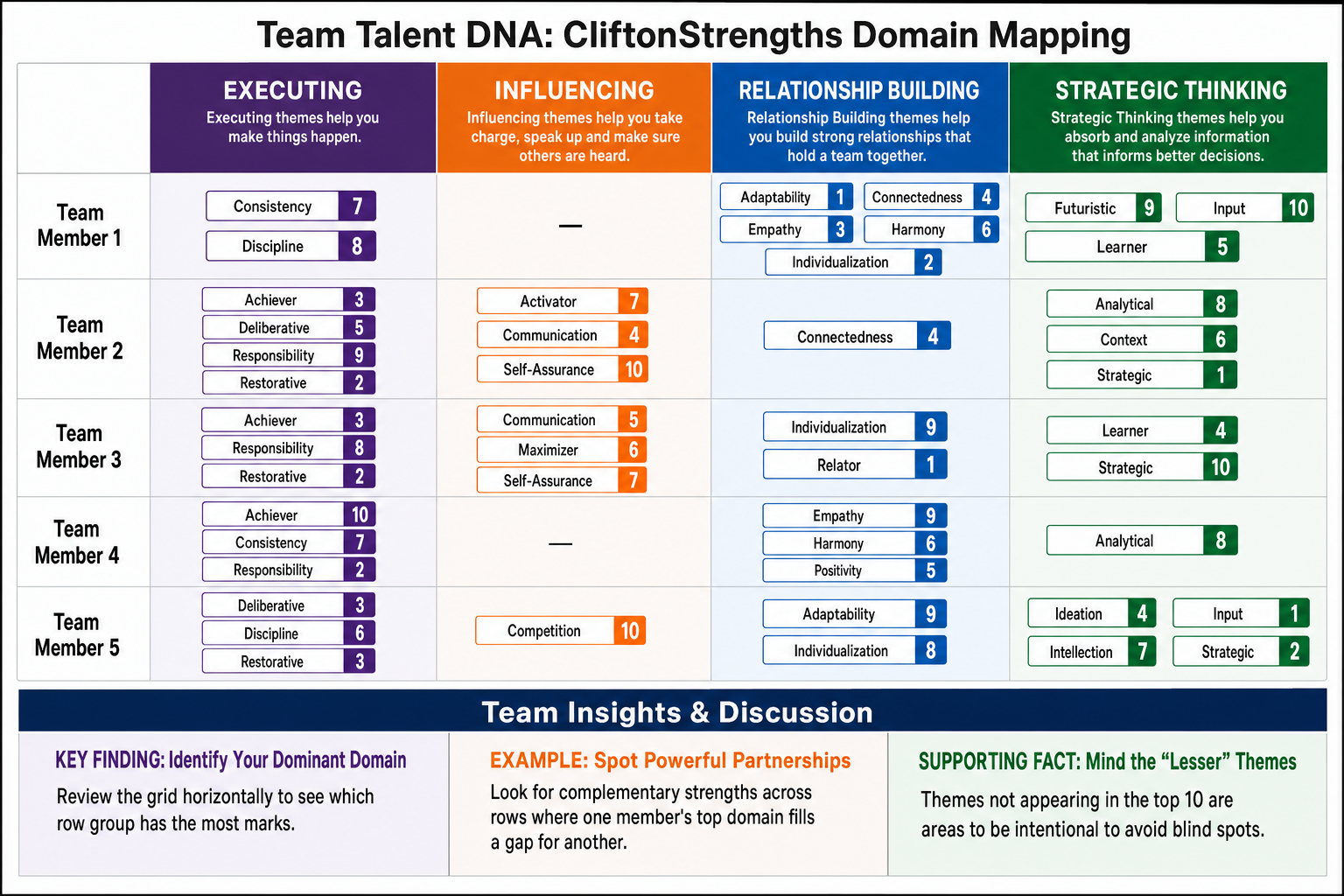
The grid explained the flatline. Three domains were richly covered: fifteen Executing marks, thirteen in Relationship Building, thirteen in Strategic Thinking. Influencing — the take-charge, speak-up, sell-the-idea domain — held just seven of the grid’s forty-eight marks, none ranked higher than Communication at №4, with no Command or Woo anywhere and two members carrying no Influencing themes at all. Worse, the themes the team led with actively worked against the ask: Team Member 1’s Empathy and Harmony, Team Member 4’s Harmony and Positivity, and Deliberative caution in the top five for Team Members 2 and 5. A team wired this way runs a flawless discovery call, writes a thoughtful proposal, and then waits politely to be chosen. Nobody was built to create urgency, push past a stall, or ask for the business.
The fix was not a sales boot camp; you cannot train Harmony into Command. It was re-seating the sale around the talent already on the grid. Team Member 2 — Strategic №1, Communication №4, Activator №7, Self-Assurance №10 — took the deal-lead seat, the only person who combined a point of view with the drive to voice it. Team Member 3 — Relator №1, Communication №5, Maximizer №6 — took expansion revenue, because Relator does not woo strangers but goes deep with existing accounts, where the next dollar was cheapest. Team Member 1’s Individualization №2 and Empathy №3 made discovery their seat: reading each buyer and tailoring the pitch one person at a time. Team Member 4’s Responsibility №2 and Consistency №7 turned follow-up into a system, so no lead aged silently in the pipeline. And Team Member 5 — Input №1, Strategic №2, Ideation №4, plus the team’s only Competition theme — built the win strategy for every must-win pursuit.
Re-seating can only redistribute the talent you already have, and the grid was blunt about what the team did not have: a natural closer. The recruiting scorecard for the next hire screened for high Influencing directly — Woo, Command, Activator — instead of another strong deliverer. Two quarters later, the close rate on qualified proposals had doubled, and the team booked back-to-back record quarters while delivery quality never slipped.
The team never had a sales-effort problem; it had an Influencing gap — so it re-seated the sale around its relationships and hired the voice it lacked.
Common Mistakes When Rolling Out CliftonStrengths
Running an assessment is easy; changing how a team operates is hard. These are the predictable errors leaders make when they introduce the framework.
Frequently Asked Questions
Is CliftonStrengths reliable over time?
Yes. Gallup’s reliability research shows that dominant themes stay highly stable over time, so a retake years later usually surfaces the same top talents in a similar order.
How long does the assessment take to complete?
Roughly 30 to 40 minutes. You get 20 seconds to respond to each of the 177 paired statements, which keeps your answers instinctive rather than overthought.
How do we integrate strengths into the employee life cycle?
Use strengths during onboarding to affirm seating decisions, in weekly check-ins to drive performance, and in reviews to coach growth. In an operating system, this maps naturally onto your accountability chart and scorecard.
Can someone succeed without themes in a specific domain?
Yes. A gap in one domain does not mean you cannot perform there. You reach the same outcome by leaning on stronger themes from other domains, or by pairing with a complementary teammate.
What is the difference between a talent and a strength?
A talent is a naturally recurring pattern of thought or behavior. A strength is the ability to deliver consistent, near-perfect performance by adding knowledge and skill to that raw talent.